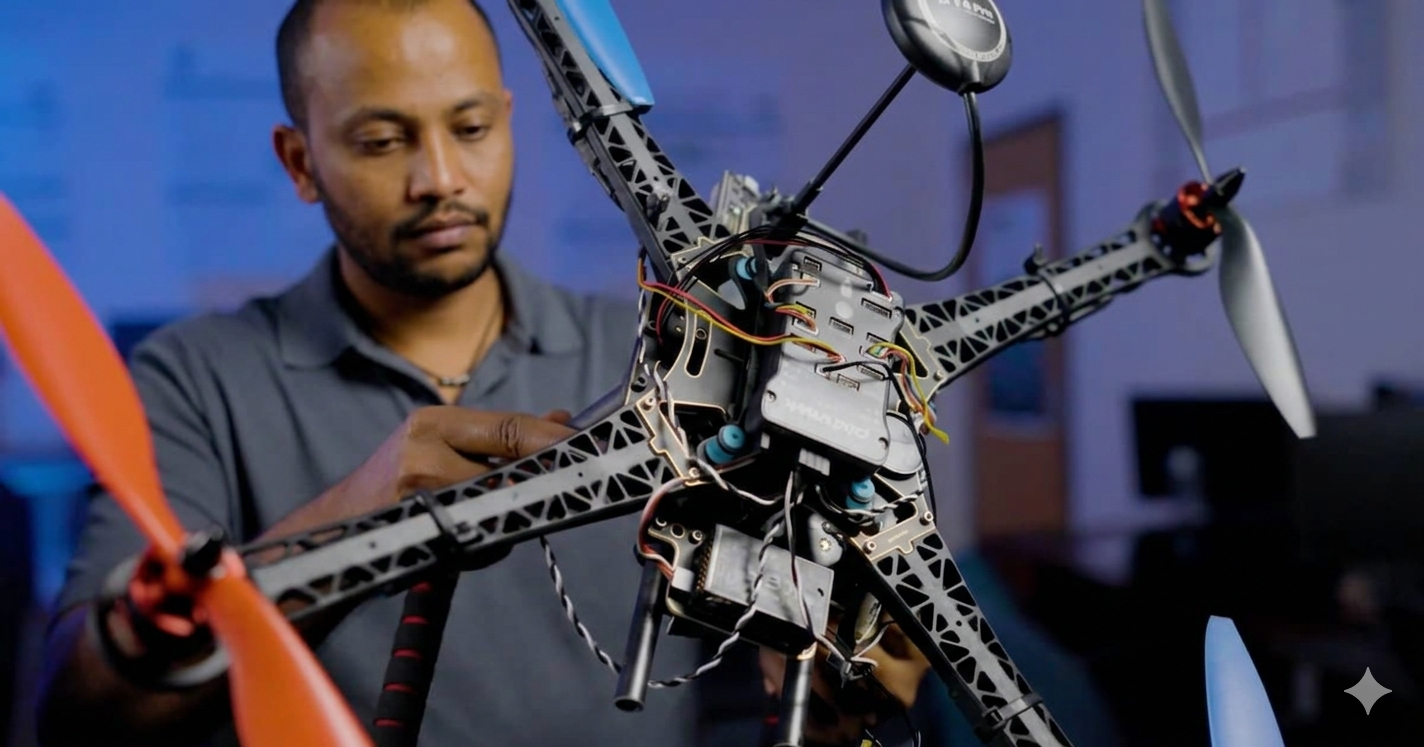
Drones, or Unmanned Aerial Vehicles (UAVs), have become ubiquitous across military, commercial, and recreational domains. They deliver packages, inspect infrastructure, capture cinematic footage, and conduct surveillance. However, as drones transition from niche gadgets to critical assets, they have also become prime targets for cyber attacks. Securing drones is no longer optional — it is essential for public safety, national security, and business continuity.
Unlike traditional IT systems, drones present a unique attack surface. They communicate over wireless links, rely on GPS for navigation, carry physical payloads, and often operate beyond visual line of sight. A successful drone hack can lead to theft of sensitive aerial data, collision with aircraft, physical property damage, or even weaponization of the UAV itself. This post explores the most common drone attack vectors — GPS spoofing, signal jamming, firmware attacks — and the defensive measures that can prevent takeover.
GPS Spoofing: Tricking the Drone's Navigation
GPS spoofing is one of the most dangerous attacks against drones. Instead of jamming the GPS signal (which causes the drone to lose navigation), spoofing broadcasts fake GPS coordinates that are stronger than legitimate satellite signals. The drone accepts these false signals as reality, allowing the attacker to control its perceived location.
In a typical GPS spoofing attack against a drone, the attacker transmits counterfeit GPS data that gradually drifts from the true position. The drone's flight controller, trusting the stronger spoofed signal, adjusts its position accordingly. The operator watching the telemetry feed sees no anomaly — the drone appears to be hovering in place — while in reality, the attacker has silently redirected it to a different location.
GPS spoofing is particularly insidious because it provides no obvious alert to the operator. From the pilot's perspective, the drone remains stable at the expected coordinates. Only a cross-check with secondary sensors (like an onboard barometer or compass) might reveal the deception.
Real-world demonstrations have shown white-hat hackers redirecting commercial drones to fake GPS waypoints, causing them to land in unauthorized zones or fly into restricted airspace. In 2011, Iranian forces claimed to have captured a CIA RQ-170 Sentinel drone using GPS spoofing, tricking it into landing on an Iranian runway instead of returning to its base.
Defenses Against GPS Spoofing
Protecting drones from GPS spoofing requires multi-layered strategies. Military-grade drones use encrypted GPS signals (M-Code) that cannot be easily forged. Commercial and consumer drones can implement GPS anti-spoofing detection by monitoring signal strength, time-of-arrival anomalies, and cross-referencing GPS with alternative navigation sources such as barometers, accelerometers, magnetometers, and visual odometry.
Some advanced drone systems use inertial navigation systems (INS) that calculate position based on acceleration and rotation, independent of external signals. When GPS data conflicts with INS calculations by a significant margin, the drone can enter a failsafe mode — hovering in place, returning to home via visual landmarks, or landing safely.
Signal Jamming: Cutting the Tether
Radio frequency (RF) jamming is a Denial-of-Service (DoS) attack against the communication link between the drone and its operator. Most consumer and commercial drones operate in unlicensed frequency bands — 2.4 GHz and 5.8 GHz — the same bands used by Wi-Fi and Bluetooth. An attacker with a high-gain transmitter can flood these frequencies with noise, overwhelming the drone's receiver.
When a drone loses connection to its controller, its behavior depends on the manufacturer's fail-safe programming. Many drones are configured to "Return to Home" (RTH) — automatically flying back to the takeoff point. Others may hover in place until the signal returns or perform an emergency landing. Attackers exploit this predictable behavior to force drones into vulnerable states.
For example, an attacker near a drone's launch point can jam the control link, triggering RTH. As the drone flies back to its home coordinates, the attacker can physically capture it or simply observe where it lands. More sophisticated attackers use selective jamming — blocking only telemetry downlinks while leaving command uplinks intact — allowing them to issue commands without the operator receiving feedback.
Defenses Against Jamming
Frequency hopping spread spectrum (FHSS) is the primary defense against jamming. FHSS causes the drone and controller to rapidly switch between dozens of frequencies according to a pseudorandom pattern known only to the paired devices. An attacker without the hopping sequence can only jam a narrow slice of the spectrum at any given moment.
Modern drone protocols like DJI's OcuSync and OcuSync 4 implement advanced FHSS alongside adaptive channel selection, automatically switching to cleaner frequencies when interference is detected. For high-security applications, drones can use directional antennas that focus transmission energy toward the operator, making jamming from other directions more difficult.
Some defense systems employ multi-link redundancy, using cellular 4G/5G as a secondary control channel. If RF jamming is detected, the drone seamlessly switches to cellular command-and-control, maintaining operator connectivity even when primary frequencies are compromised.
Firmware and Software Attacks
Firmware attacks target the drone's onboard software — the flight controller, autopilot system, or companion computer. Unlike jamming or spoofing, which manipulate external signals, firmware attacks compromise the drone from within. Attack vectors include malicious firmware updates, rootkits, supply chain tampering, and exploitation of unpatched vulnerabilities.
Many drones allow over-the-air (OTA) firmware updates for convenience. However, if the update mechanism lacks cryptographic signing, an attacker can inject malicious firmware that appears legitimate. A compromised drone could ignore operator commands, exfiltrate video streams to third-party servers, or even intentionally crash on command.
A drone running compromised firmware is no longer under the operator's control — it becomes a puppet for the attacker. The most sophisticated firmware implants can remain dormant for weeks, activating only when the drone enters a specific geofenced area.
Research has demonstrated practical attacks against popular drone platforms. In 2021, security researchers disclosed multiple vulnerabilities in a leading drone's SDK that allowed unauthenticated attackers to gain root access via the drone's Wi-Fi access point. Another attack chain involved intercepting and modifying firmware update packages by exploiting weak TLS implementations on update servers.
Defenses Against Firmware Attacks
Secure boot is the foundation of drone firmware security. The drone's bootloader verifies a cryptographic signature on the firmware before executing it. If the signature is invalid — or signed by an unauthorized key — the drone refuses to boot. This prevents attackers from replacing the official firmware with malicious code.
Encrypted and signed OTA updates ensure that even if an attacker intercepts the update file, they cannot modify it or install it on unauthorized devices. The drone should verify both the authenticity (who signed it) and integrity (has it been altered) before applying any update. Additionally, drones should implement rollback protection to prevent attackers from forcing the device to revert to an older, vulnerable firmware version.
Regular vulnerability scanning and penetration testing of drone firmware and companion apps help identify security gaps before attackers exploit them. For high-assurance environments, drones can be operated without OTA updates entirely, with all firmware updates performed via physically secured USB connections in controlled facilities.
Eavesdropping and Data Interception
Drones transmit a wealth of sensitive data: live video feeds, telemetry (altitude, speed, battery, GPS coordinates), and sometimes even payload data from attached sensors. Without encryption, anyone within radio range can eavesdrop on this traffic using low-cost software-defined radios (SDRs) like the HackRF One or RTL-SDR.
A passive eavesdropper can record video streams, track the drone's flight path, and identify the operator's location by triangulating the signal. In military or law enforcement contexts, intercepted drone footage could reveal tactical positions, surveillance targets, or ongoing operations. Commercial drones carrying package delivery data might leak customer addresses and delivery schedules.
Some drone manufacturers historically transmitted video feeds without encryption or with weak proprietary scrambling. In 2019, researchers discovered that several popular drone models transmitted video using a static XOR key that could be recovered from the mobile app, allowing anyone to decrypt live footage with open-source tools.
Defenses Against Eavesdropping
WPA2 or WPA3 encryption for Wi-Fi-based drone links is essential. For drones using proprietary radio protocols, AES-128 or AES-256 encryption should be enabled by default, with keys derived from a pairing process that prevents replay attacks. The drone and controller should perform mutual authentication before any data exchange.
For maximum security, drone operators can implement VPN tunnels over cellular connections, encrypting all traffic between the drone and a ground control station. However, this adds latency and requires reliable cellular coverage. Military drones often use frequency-hopping spread spectrum combined with link-layer encryption and periodic key rotation to resist both jamming and eavesdropping.
Defensive Countermeasures: The Complete Security Stack
No single defense is sufficient. A secure drone deployment requires a layered approach:
Physical Security – Tamper-evident seals, locked storage, and hardware anti-tamper mechanisms that zeroize encryption keys if the drone casing is opened.
Network Security – Encrypted command and telemetry links, mutual authentication between drone and controller, and intrusion detection systems that monitor for anomalous flight patterns.
Software Security – Secure boot, signed firmware updates, memory protection, and minimal attack surface (disabling unnecessary services like unauthenticated debug interfaces).
Operational Security – Geographic fencing, pre-flight security checks, real-time monitoring of GPS and signal health, and documented incident response procedures for suspected spoofing or jamming.
Final Thoughts
Drone cyber security is still a maturing field, but the threats are already real. GPS spoofing can redirect drones without alerting operators. Signal jamming can trigger predictable fail-safe behaviors. Firmware attacks can permanently compromise UAVs. Eavesdropping can leak sensitive video and telemetry data.
As drones become more autonomous and integrated into critical infrastructure — power grid inspection, emergency medical delivery, law enforcement surveillance — the consequences of successful attacks will only escalate. Manufacturers must prioritize security-by-design: encrypted links, secure boot, signed updates, and multi-sensor navigation redundancy. Operators must treat drones as networked computing devices, not just flying cameras.
Understanding the attack surface is the first step toward defense. Whether you are a hobbyist, a commercial operator, or a security professional, the principles of drone cyber security — trust no signal, encrypt everything, verify all updates — apply equally. The sky is not the limit; it is the new attack surface.