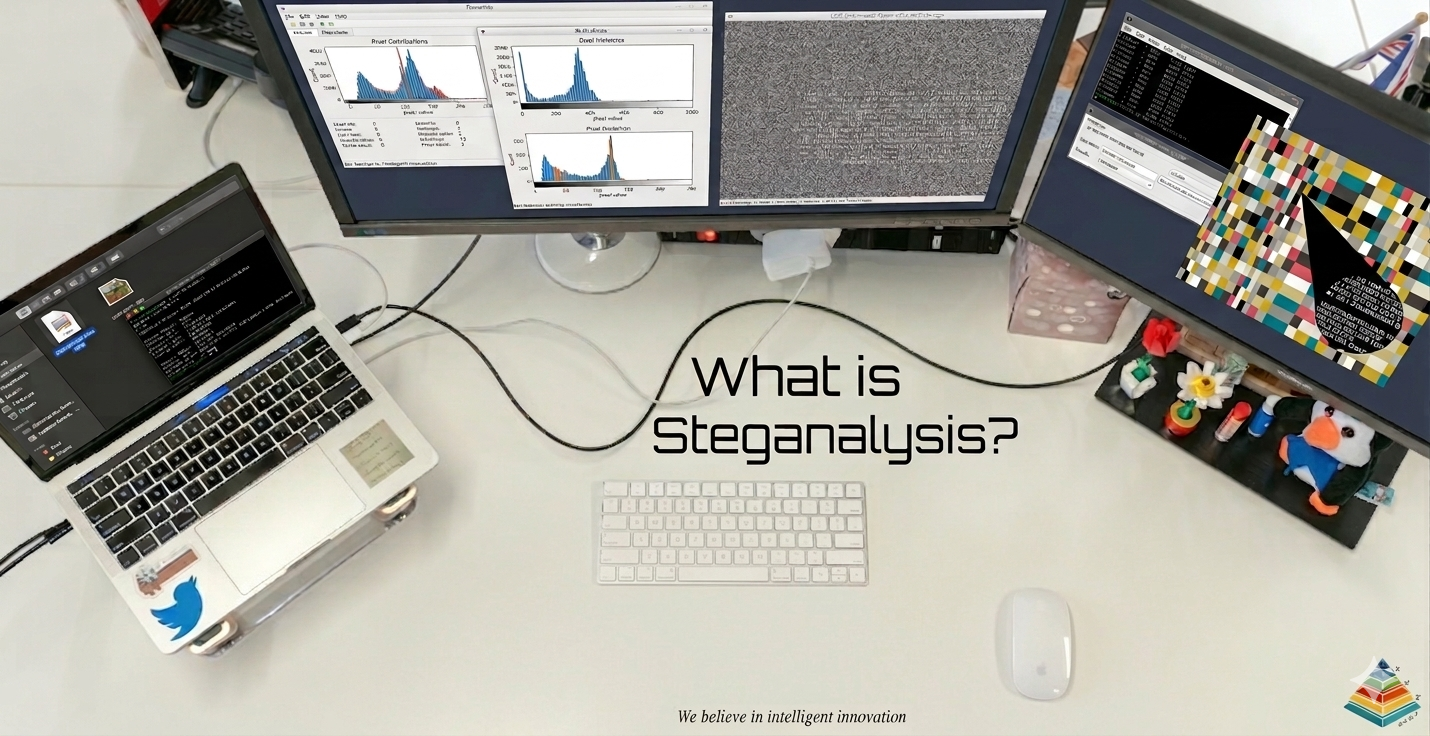
Steganalysis is one of the most important techniques used in modern cyber security and digital forensics. It focuses on detecting hidden information embedded inside digital media such as images, audio files, videos, documents, and network traffic. While steganography is designed to hide secret messages without attracting attention, steganalysis attempts to discover whether hidden communication exists and identify the techniques used to conceal that information.
In recent years, cyber criminals, malware developers, and threat actors have increasingly used hidden communication channels to bypass traditional security systems. Because of this, steganalysis has become an important field in digital investigation, malware analysis, intelligence operations, and secure communication monitoring. Researchers and security professionals continuously develop advanced detection systems capable of identifying hidden payloads inside seemingly harmless files.
Unlike cryptography which scrambles messages to make them unreadable, steganography hides the very existence of the message. This forces defenders to analyze subtle statistical anomalies rather than looking for encrypted data. Steganalysis bridges this gap by applying forensic techniques to detect, extract, and disrupt covert communication channels.
Types of Steganalysis Techniques
Steganalysis encompasses multiple approaches, each with distinct strengths and limitations. Passive steganalysis simply determines whether hidden data exists. Active steganalysis goes further by attempting to extract or destroy the concealed message. Universal steganalysis aims to detect any embedding method without prior knowledge of the steganography tool used.
Statistical steganalysis examines mathematical properties of media files. It looks for deviations from expected distributions, such as histogram anomalies in image pixel values or unusual pair correlations. Chi-square analysis is a classic example, detecting LSB embedding by measuring how evenly pairs of pixel values are distributed.
Signature-based detection scans for known patterns left by popular steganography tools like Steghide, OpenPuff, or OutGuess. While fast and reliable for known threats, this method fails against custom or obfuscated steganography.
Steganalysis is not only about detecting hidden messages — it is about understanding how attackers secretly communicate through digital content while avoiding traditional security detection systems.
Machine learning and deep learning have revolutionized steganalysis. Convolutional neural networks (CNNs) can automatically learn hierarchical features from raw pixel data, achieving higher accuracy than handcrafted statistical features. Modern research explores transformer-based architectures and universal detectors that generalize across multiple embedding algorithms.
Visual detection uses human inspection or image processing techniques like bit-plane slicing and contrast enhancement. While impractical for large-scale analysis, it remains valuable for forensic investigators examining a small number of suspicious files.
Image-Based Steganalysis in Practice
Image steganalysis is the most researched area because images provide abundant data for hiding messages. The Least Significant Bit (LSB) method is common: binary data is inserted into the smallest bits of image pixels, creating no perceptible change to human observers.
However, LSB embedding introduces statistical artifacts. Adjacent pixel values become artificially correlated, and color histograms show unexpected pair distributions. A chi-square test can detect this by comparing observed versus expected value frequencies across the image.
 Digital Image Steganalysis Process
JPEG images present unique challenges because compression removes redundant data. Steganography in the frequency domain — modifying discrete cosine transform (DCT) coefficients — leaves traces in coefficient distributions. Tools like StegExpose and Jsteg specifically target these frequency-domain anomalies.
Real-world forensic investigations combine multiple methods. A suspicious image might undergo bit-plane slicing, then chi-square analysis, then machine learning verification. This layered approach reduces false positives and increases detection confidence.
Applications in Cyber Security
Steganalysis has many important applications in the cyber security industry. Digital forensic investigators use it during criminal investigations to recover hidden evidence from suspicious files. Malware analysts use steganalysis to identify malicious payloads hidden inside images or media files. Intelligence organizations use these techniques to monitor covert communication channels used by attackers and cyber espionage groups.
Modern organizations also apply steganalysis in:
- Threat Intelligence Platforms
- Secure Email Systems
- Data Leakage Prevention
- Malware Detection Systems
- Cloud Security Monitoring
- Network Traffic Inspection
- Digital Evidence Investigation
For example, banking trojans like Zeus and Trickbot have hidden configuration files inside images hosted on legitimate platforms. Steganalysis tools integrated into network monitoring can detect these hidden configurations by analyzing image downloads from untrusted sources.
Nam ut rutrum ex, venenatis sollicitudin urna. Aliquam erat volutpat. Integer eu ipsum sem. Ut bibendum lacus vestibulum maximus suscipit. Quisque vitae nibh iaculis neque blandit euismod.
AI and Computer Vision in Steganalysis
Artificial intelligence has transformed modern steganalysis research. Deep learning models can automatically learn hidden image patterns and detect concealed information with higher accuracy than traditional statistical approaches. Computer vision systems analyze textures, image noise, pixel distribution, and compression patterns to identify suspicious files.
Researchers are now building convolutional neural networks (CNNs) and transformer-based architectures capable of detecting advanced steganographic methods used in real-world cyber attacks. AI-powered steganalysis systems are becoming faster, more scalable, and more accurate for enterprise security environments.
AI-driven steganalysis is shaping the future of digital forensics, cyber intelligence, and intelligent threat detection systems.
However, AI-based steganalysis faces challenges. Adversarial attacks can add minimal noise to fool neural network classifiers. Generative steganography — where an AI creates cover media around a hidden message — produces no classic embedding artifacts, creating an ongoing arms race between detection and concealment.
Final Thoughts
As cyber threats continue to evolve, hidden communication methods are becoming more sophisticated and difficult to detect. Steganalysis provides security professionals with the ability to uncover concealed information, investigate suspicious digital activity, and strengthen cyber defense systems against covert attacks.
Understanding steganalysis is important for anyone interested in cyber security, artificial intelligence, computer vision, digital forensics, and intelligent security technologies. With the rapid growth of AI-powered systems, the future of steganalysis will continue to become more advanced and essential in modern digital security operations.
For security teams, steganography is no longer a theoretical threat. It is actively used in malware distribution, data exfiltration, command-and-control communication, and corporate espionage. Deploying modern steganalysis tools — including statistical analyzers, deep learning detectors, and traffic monitors — is becoming as fundamental as deploying antivirus or firewalls.