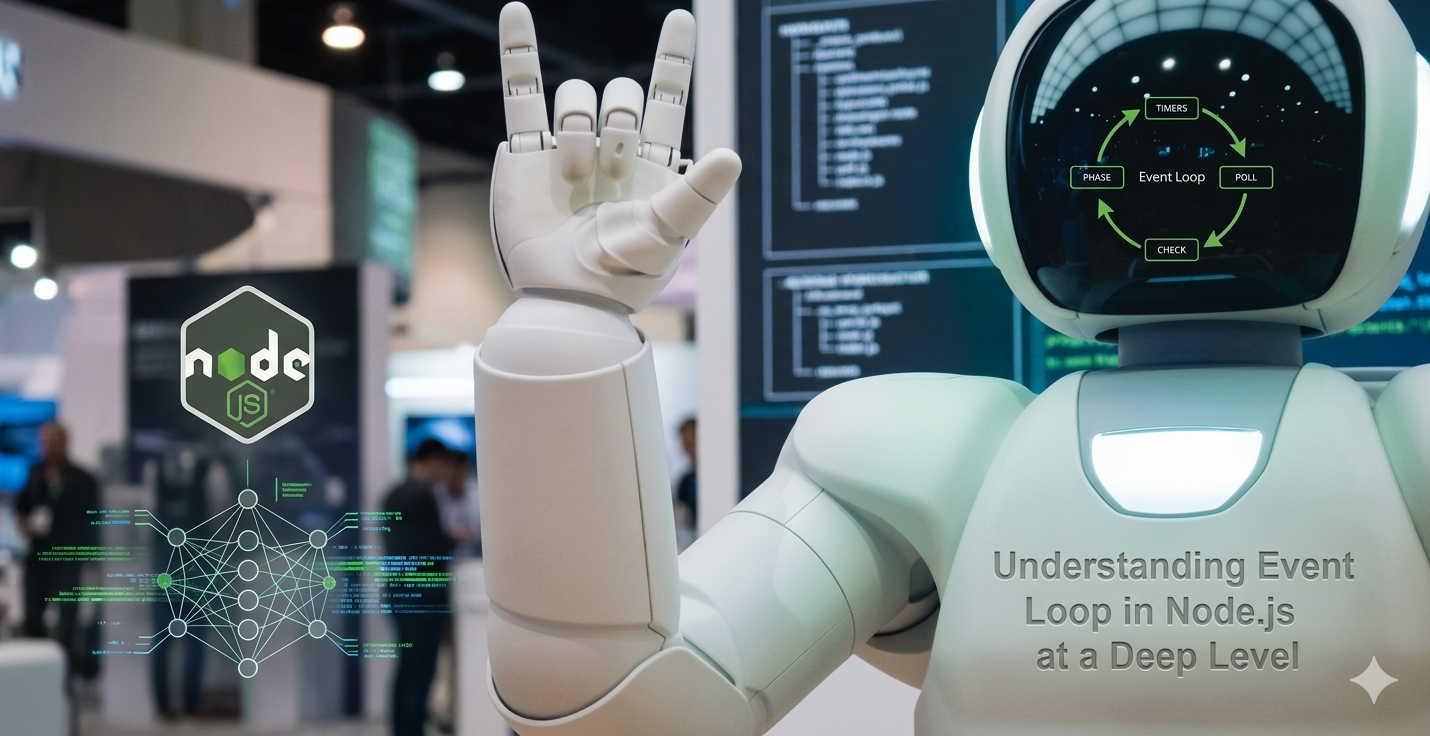
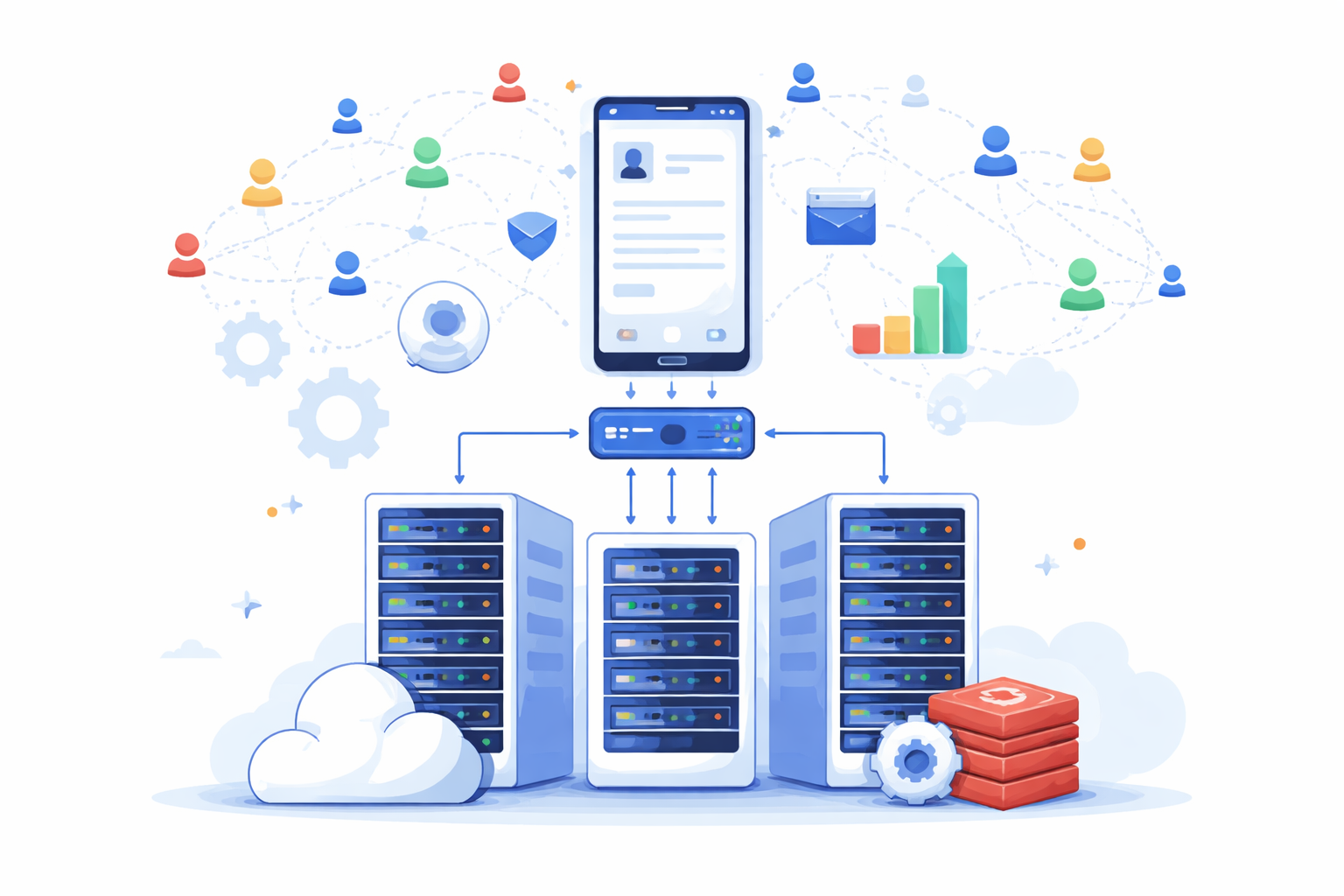
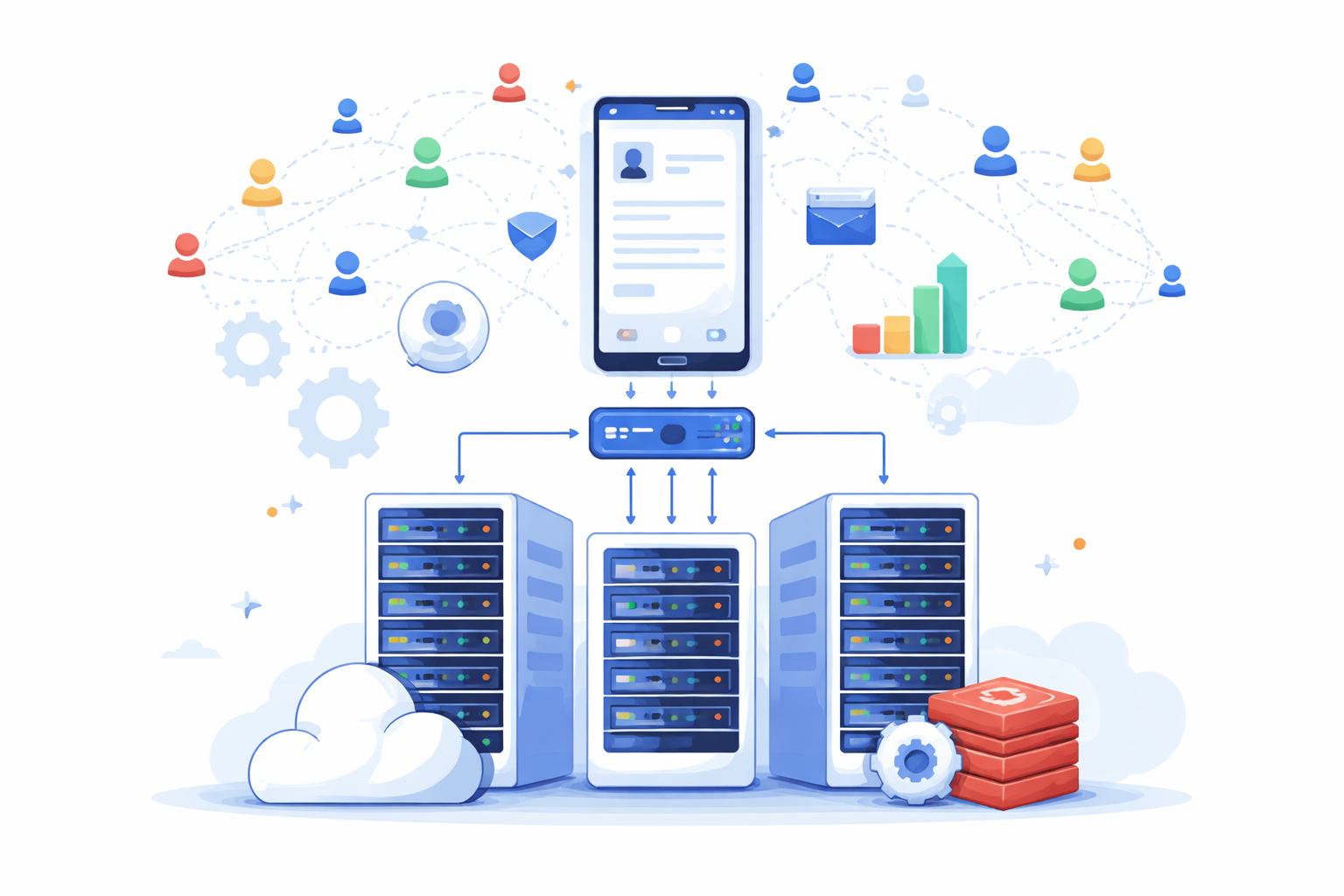
The event loop is the core mechanism that enables Node.js to handle asynchronous operations efficiently despite being single-threaded. It allows Node.js to perform non-blocking I/O operations — such as reading files, querying databases, or making network requests — without waiting for each operation to complete before moving to the next. Understanding the event loop at a deep level is essential for writing performant, predictable, and bug-free Node.js applications.
Unlike traditional multi-threaded servers that spawn a new thread for each connection, Node.js uses a single main thread with an event-driven architecture. The event loop continuously checks for pending tasks, executes callbacks, and schedules work across different phases. This design makes Node.js highly scalable for I/O-bound workloads, but it also introduces unique challenges around blocking operations, microtask ordering, and callback execution order.
In recent years, as Node.js has matured, developers have gained more control over the event loop through setImmediate, process.nextTick, queueMicrotask, and Worker Threads. However, many developers still struggle to predict execution order in complex asynchronous code. This post will demystify the event loop by exploring its internal phases, task queues, and the subtle rules that govern callback scheduling.
The Six Phases of the Event Loop
The event loop operates in a continuous cycle, moving through several distinct phases in a specific order. Each phase maintains a queue of callbacks to execute. Once a phase's queue is empty or reaches a maximum limit, the event loop moves to the next phase.
The complete phase order is: Timers (executes setTimeout and setInterval callbacks), Pending Callbacks (executes I/O callbacks deferred to the next loop iteration), Idle/Prepare (used internally by Node.js), Poll (retrieves new I/O events and executes I/O-related callbacks), Check (executes setImmediate callbacks), and Close Callbacks (executes close event callbacks like socket.on('close')).
Between each phase, the event loop processes microtasks from process.nextTick and Promise resolutions. This interleaving is critical to understanding execution order. Microtasks are fully drained before the event loop moves to the next phase, which means recursively scheduling microtasks can block the event loop indefinitely.
The event loop is not a simple FIFO queue. It prioritizes microtasks between every phase, and the distinction between macrotasks (timers, I/O, setImmediate) and microtasks (nextTick, Promises) is what creates the non-intuitive ordering many developers encounter.
Microtasks vs Macrotasks
One of the most misunderstood aspects of the event loop is the difference between microtasks and macrotasks. All callbacks are not equal — microtasks are executed immediately after each phase completes and before moving to the next phase, while macrotasks are processed phase by phase.
Macrotasks include setTimeout and setInterval callbacks (Timers phase), I/O callbacks (Poll phase), setImmediate callbacks (Check phase), and event listener callbacks. Microtasks include process.nextTick callbacks (highest priority microtask), Promise.then, Promise.catch, and Promise.finally callbacks, as well as queueMicrotask() callbacks.
The critical rule is that all microtasks are fully drained before the event loop moves to the next phase. If a microtask schedules another microtask recursively, the event loop can be blocked indefinitely — this is a common source of application freezes.
// Example demonstrating phase ordering
setTimeout(() => console.log('setTimeout (timers phase)'), 0);
setImmediate(() => console.log('setImmediate (check phase)'));
Promise.resolve().then(() => console.log('Promise microtask'));
process.nextTick(() => console.log('nextTick microtask'));

// Actual output order (in most cases):
// nextTick microtask
// Promise microtask
// setTimeout OR setImmediate — order depends on loop timing
The Poll Phase and I/O Scheduling
The Poll phase is the heart of the event loop. It performs two primary functions: calculating how long to block for new I/O events, and executing I/O-related callbacks. The behavior of the Poll phase depends on the state of other queues.
If the Check phase queue is not empty, the Poll phase will not block — it will immediately proceed to Check. If there are pending timers, the Poll phase will block only until the nearest timer's threshold is reached. If no timers or Check callbacks exist, the Poll phase can block indefinitely waiting for new I/O events.
This explains why setImmediate and setTimeout(fn, 0) have non-deterministic ordering when called outside an I/O cycle. However, inside an I/O callback, setImmediate will always execute before a setTimeout(fn, 0) because the Poll phase hands off directly to the Check phase.
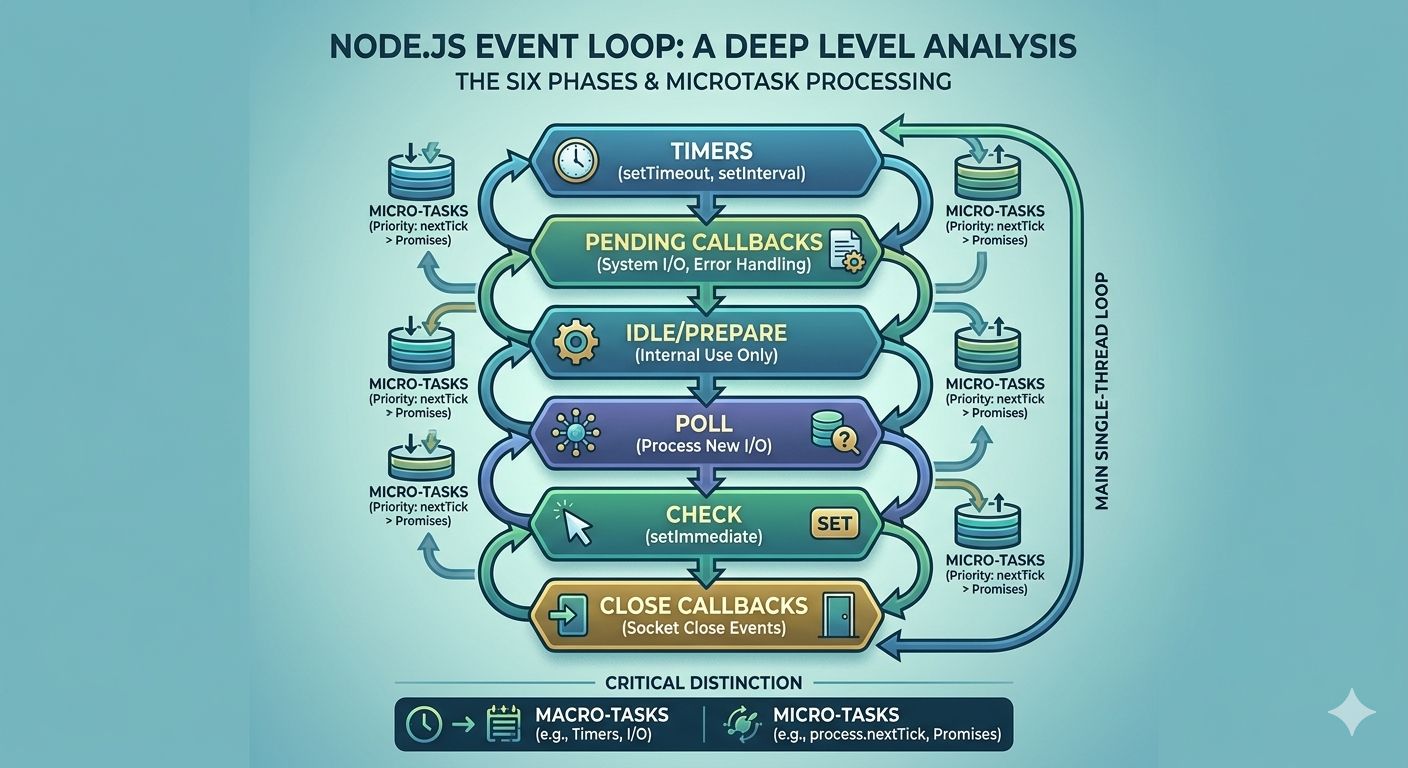 Node.js Event Loop Phase Diagram
Node.js provides three primary ways to defer execution, each with distinct event loop behavior. process.nextTick schedules a callback to execute at the end of the current operation, before any I/O or timers. It belongs to the microtask queue but receives special priority — nextTick callbacks execute before Promise microtasks in practice, even though both are technically microtasks.
setImmediate schedules a callback in the Check phase, which runs after the Poll phase completes. Despite its name, it does not execute "immediately" — it waits for the current Poll phase to finish. setTimeout(fn, 0) schedules a callback in the Timers phase. The minimum delay is actually 1ms in Node.js, and the callback will not execute until the Timers phase is reached in the next loop iteration.
// Order demonstration
setTimeout(() => console.log('setTimeout'), 0);
setImmediate(() => console.log('setImmediate'));
process.nextTick(() => console.log('nextTick'));
Promise.resolve().then(() => console.log('promise'));

// Output (reliable order):
// nextTick
// promise
// setTimeout OR setImmediate (depends on event loop state when script starts)
Understanding the event loop means understanding that process.nextTick is not truly "next" — it's actually "as soon as humanly possible before anything else." This power comes with responsibility: recursively calling nextTick will starve the event loop entirely.
Blocking the Event Loop
Because Node.js runs JavaScript on a single thread, any synchronous blocking operation will stall the entire event loop. During this stall, no timers fire, no I/O completes, and no other callbacks execute. The application effectively freezes.
Common blocking operations include synchronous file system methods (readFileSync, writeFileSync), heavy CPU-bound calculations (image processing, encryption, sorting large arrays), infinite loops or recursive microtask scheduling, JSON.parse on massive objects, and regular expression evaluation on large strings that causes catastrophic backtracking.
// This blocks the event loop completely for 5 seconds
const start = Date.now();
while (Date.now() - start < 5000) {
  // Busy-wait — no timers, no I/O, nothing else runs
}
console.log('Finally done — but every other operation was delayed');
To handle CPU-intensive operations without blocking the event loop, Node.js provides Worker Threads. Workers run JavaScript in parallel threads, each with its own event loop, enabling true parallelism for computational tasks.
Debugging event loop issues requires specialized tools and techniques. Node.js provides built-in --trace-events-enabled and the perf_hooks module to monitor event loop delay. The node:diagnostics_channel module offers event loop timing data for advanced monitoring.
A common production pattern is to measure event loop lag using setInterval to detect when callbacks are being delayed beyond acceptable thresholds. Event loop lag is often the first symptom of blocking operations or microtask starvation.
Popular APM tools like Datadog, New Relic, and Dynatrace monitor event loop lag in production and can alert teams when the event loop is struggling to keep up with demand.
Final Thoughts
The Node.js event loop is a beautiful piece of systems engineering that enables high-concurrency I/O with a single thread. However, its power comes with complexity. Understanding the phase order, the microtask vs macrotask distinction, and the precise behavior of nextTick, setImmediate, and setTimeout is essential for any serious Node.js developer.
In practice, most event loop bugs trace back to one of three root causes: unexpected microtask recursion, a synchronous blocking operation in a critical path, or incorrect assumptions about the order of timer callbacks. By mastering the deep internals of the event loop, you can write Node.js applications that are both fast and predictable — even under heavy load.
As Node.js continues to evolve with new features, the event loop remains the unchanged foundation upon which all asynchronous JavaScript in Node.js is built. Understanding it isn't just an interview requirement — it's a practical necessity for production-grade Node.js development.